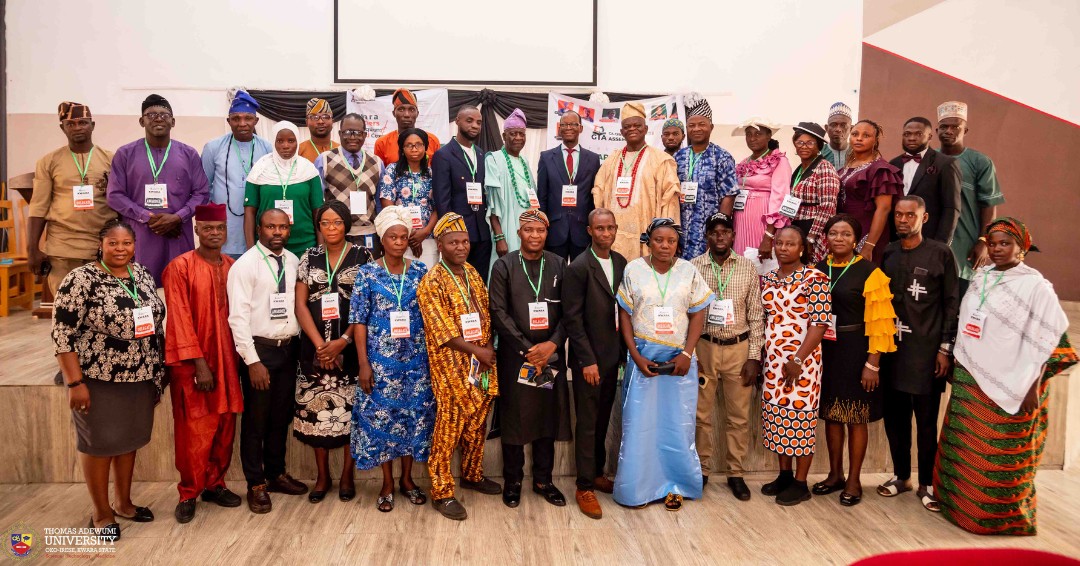
Thomas Adewumi University hosted the 2nd edition of its Faculty Seminar Series, further advancing its commitment to research-driven discourse and interdisciplinary collaboration.
The seminar, organized by the Directorate of Research, Innovations and Product Development (DRIPDEV), featured a compelling presentation titled “Nutraceutical Synergism: Shielding the Liver from Environmental Assaults,” delivered by Mr. Emmanuel T. Akinlade of the Department of Physiology, Faculty of Basic Medical and Health Sciences.
Welcoming participants to the session, the Director of DRIPDEV, Dr. Eniafe F. Ayetiran, appreciated the presence of Deans, Directors, and distinguished scholars from across faculties. He reiterated the objective of the Faculty Seminar Series as a platform to promote scholarly engagement and knowledge sharing across disciplines.
Dr. Ayetiran noted that the second edition of the series spotlighted the Faculty of Basic Medical and Health Sciences, following the maiden edition hosted by the Faculty of Arts and Humanities. He introduced the seminar topic and speaker, describing Mr. Akinlade as a dedicated lecturer and researcher whose work continues to contribute to advancements in physiological science.
The citation of the speaker highlighted Mr. Akinlade as a scholar specializing in Human Physiology, with a focus on applied and environmental physiology, and a member of the Physiological Society of Nigeria.
In his presentation, Mr. Akinlade provided a comprehensive overview of nutraceuticals, defining them—based on the work of Stephen DeFelice (1989)—as foods or components of food that offer medical or health benefits, including disease prevention and treatment. He explained that nutraceuticals possess characteristics of both nutrients and pharmaceuticals and can be categorized based on their sources and chemical constituents, including bioactive dietary and herbal components.
The presentation further examined the liver, emphasizing its critical role in maintaining physiological balance through functions such as detoxification, bile production, regulation of blood composition, and metabolism of substances including alcohol and medications.
Addressing environmental assaults, Mr. Akinlade described them as chemical, biological, and physical agents capable of causing harmful biological effects. He noted that these toxicants—commonly found in air, water, and soil—pose significant health risks, particularly with chronic exposure. Examples highlighted included pesticides, industrial waste products, diesel emissions, mercury, and other environmental contaminants.
He paid particular attention to Chlorpyrifos, an organophosphate compound widely used in agriculture, explaining its pathways of exposure through food, water, air, occupational hazards, and skin contact. He detailed its mechanisms and potential health impacts, including neurological disorders, immune system dysfunction, and reproductive and endocrine disruptions.
Mr. Akinlade also distinguished between acute and chronic toxicity, noting that while acute toxicity results from short-term, high-level exposure, chronic toxicity arises from prolonged exposure to lower doses, leading to cumulative damage over time.
A key focus of the seminar was the hepatoprotective role of nutraceuticals. He explained that nutraceuticals help reduce oxidative stress, enhance glutathione levels, and improve enzyme activity, thereby protecting the liver from damage. He further explored the concept of nutraceutical synergism, highlighting how combinations such as methionine and Vitamin C can improve liver function by increasing enzyme activity, boosting glycogen content, and reducing lipid peroxidation.
In his concluding remarks, Mr. Akinlade emphasized practical recommendations, including the promotion of nutritionally rich diets, reduction of pesticide exposure, integration of nutraceuticals into preventive healthcare, and the need for further clinical research on nutraceutical combinations. He also encouraged healthier lifestyle choices, humorously suggesting the replacement of sugary snacks with fruits during meetings.
He underscored that while environmental toxins may not always be controllable, individuals can strengthen their body’s defense mechanisms through proper nutrition and metabolic preparedness. According to him, the future of preventive medicine lies at the intersection of nutrition, physiology, and molecular science.
The seminar concluded with an engaging question-and-answer session, where participants contributed insights and deepened discussions on environmental health and preventive strategies.
The 2nd Faculty Seminar Series once again demonstrated Thomas Adewumi University’s leadership in fostering academic excellence, innovative research, and solution-oriented scholarship. By creating platforms for critical engagement on contemporary global health issues, TAU continues to position itself as a hub for impactful research and intellectual advancement.